
Customer need
Organize roofing pages around the question a customer is actually trying to solve.
ROOFING PSEO SYSTEM
A pSEO structure for roofing contractors that makes repair, replacement, inspection and quote journeys clearer across verified service territories.
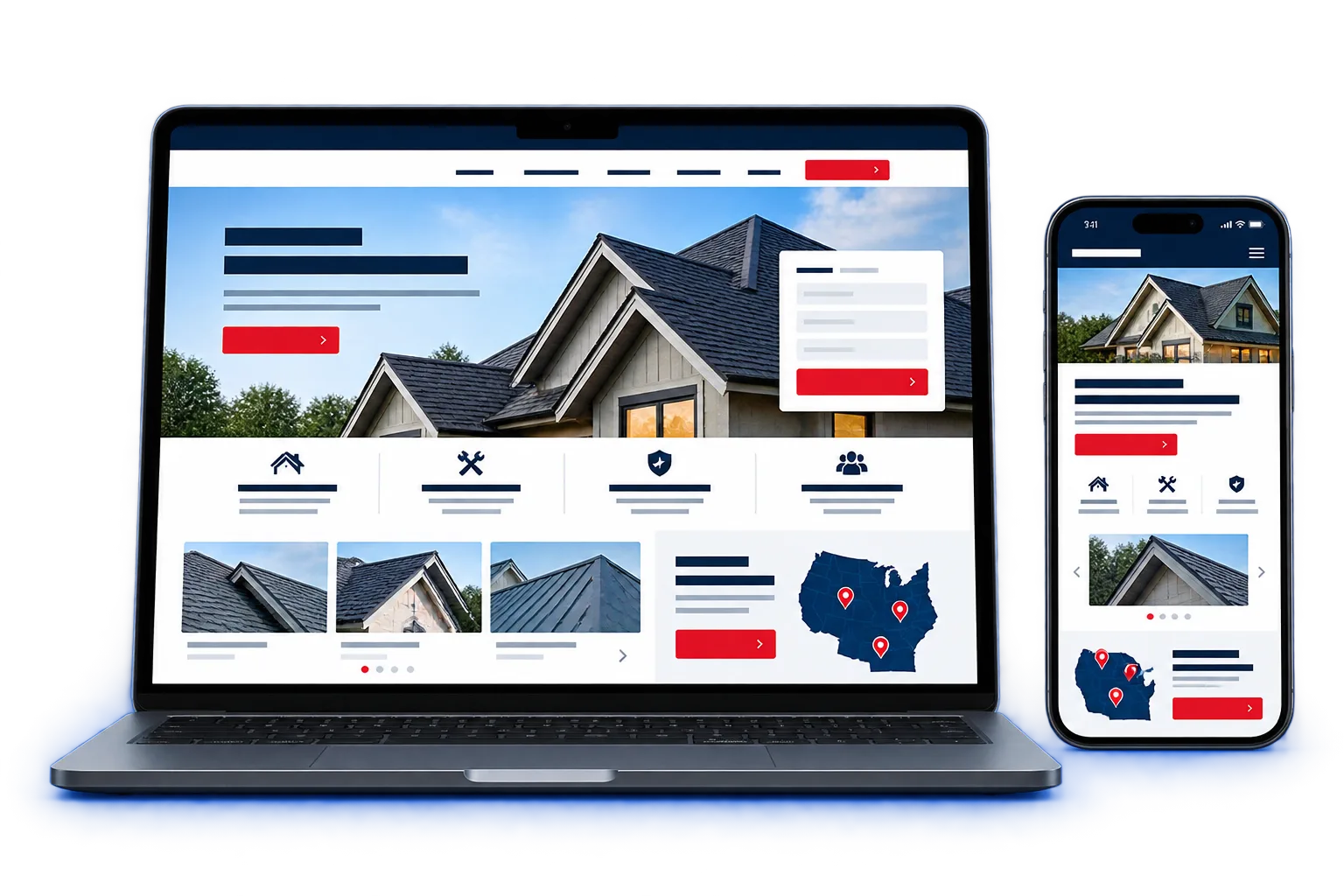
A VISUAL SYSTEM FOR THE NICHE
Show the service, market proof and next action clearly across the device experience visitors actually use.
01 Industry · Search-ready
The industry context
Roofing searches mix urgency, property type, material choice and project scope. Useful pages guide a customer through those decisions without making unverified emergency, warranty or service-area claims.
This approach is designed for Roofing contractors, roof-repair specialists, commercial roofing teams, exterior renovation firms and verified multi-location service networks.
Related decision models
Service businesses where coverage, urgency, property context and a practical enquiry route need to stay aligned. The shared planning context is useful; the final content, service evidence and market boundaries still need to be specific to the business.
Customer journeys
Organize roofing pages around the question a customer is actually trying to solve.
Separate services only where the scope, process or customer expectation genuinely changes.
Use cities, regions or countries only where the commercial territory and local context are approved.
Give visitors useful process, scope and evidence context before asking them to enquire.
Keep specialist terminology and claims connected to the people who can review them.
Route each page toward the enquiry, consultation, quote or viewing process the business can fulfil.
WEBSITE TEMPLATE DIRECTIONS
These are visual and structural directions, not off-the-shelf clones. Every final site is designed around the business, approved markets, content evidence and conversion workflow.

A direct, premium website concept for a focused roofing offer and the first approved market.
A content-rich direction that helps buyers understand a complex roofing service before they contact you.
A scalable website direction for businesses expanding from one proven market into selected territories.
A guidance-led concept for longer research cycles, specialist questions and high-consideration buyers.
A higher-end website direction where visual confidence, service clarity and scalable search structure work together.
Development + SEO, together
The visual interface, component library, page relationships, performance budget and pSEO rules are planned together. That keeps the site coherent for a visitor and maintainable for the people who will add the next approved service, market or language.
We can also adapt the content you already own: service pages, proposals, technical notes, case material, FAQs and team knowledge are reviewed, reorganised and expanded only where they support a real buyer decision.
Route model
The examples below are structural patterns, not claims of service coverage, local offices, capacity or commercial availability.
Content standard
Explain what the business provides, who it is for and where the service boundary sits.
Confirm each territory and local statement before it becomes an indexable route.
Use category-specific wording only when a responsible owner can review it.
Answer the questions that help a visitor decide whether the offer is relevant.
Use original, approved imagery and interface direction that helps the buyer understand the service.
Connect each route to a next step that matches the real operating workflow.
ROOFING INVESTMENT GUIDE
The main work is making a specialist offer, authority signals and the consultation path clear to the right buyer. This industry uses a base investment on the public starting investment.
Quality gate
New combinations are added through a controlled review. The goal is to keep each destination useful, accurate and connected to a real operating decision as the system expands.
ROOFING FOUNDATION
The page family earns its place only when it joins verified service information, market reality and a clear customer path.
Define the service, intended customer and commercial question before any market route is considered.
Include only territories the responsible business can genuinely support and explain.
Map the visitor question each page should answer instead of producing interchangeable location labels.
Use facts, terminology and visuals that can be reviewed by the people who own the market.
Connect each destination to an appropriate next step and the related information visitors need.
Add new combinations through an approval process that protects accuracy and maintainability.
ROOFING FAQ
It connects a supported roofing offer to a distinct customer decision, approved market context and a practical next step. Changing a location name alone is not enough.
Yes, when each service has a clear role, approved source material and a useful relationship to the target market and customer journey.
Coverage is selected from confirmed operating areas and commercial priorities. The structure excludes markets that cannot be supported with accurate service and local context.
A shared foundation can work, but each country needs review for service fit, terminology, operating restrictions, content evidence and conversion routing.
No. A route is not proof of coverage, availability, licensing, local presence or capacity. Those statements require explicit confirmation from the responsible operator.
The project should name the person or team responsible for industry terminology, service facts, market restrictions and any statement that needs professional or regulatory review.
Yes, after existing routes, content quality, technical constraints, information ownership and conversion paths have been assessed.
The initial routes are reviewed for useful intent, accuracy, technical quality and maintenance workload. Expansion follows only where the next combinations meet the same standard.
It answers a genuine customer question using a supported offer, a meaningful market context and a clear next step. A changed place name alone is not enough.
Every route has an explicit role, source inputs, relationship to nearby pages and an approval boundary. Unsupported or repetitive combinations stay out of the system.
Yes. A controlled pilot can begin with one market or page family, then expand only when the offer, local inputs and operating ownership are ready.
The service boundary, market coverage, language accuracy, current commercial details and the conversion path should be confirmed by the responsible team.
READY TO PLAN THE FIRST MARKET?
Start with the offer, the first approved territory and the customer decision that needs a clearer route.
Plan your Roofing system →